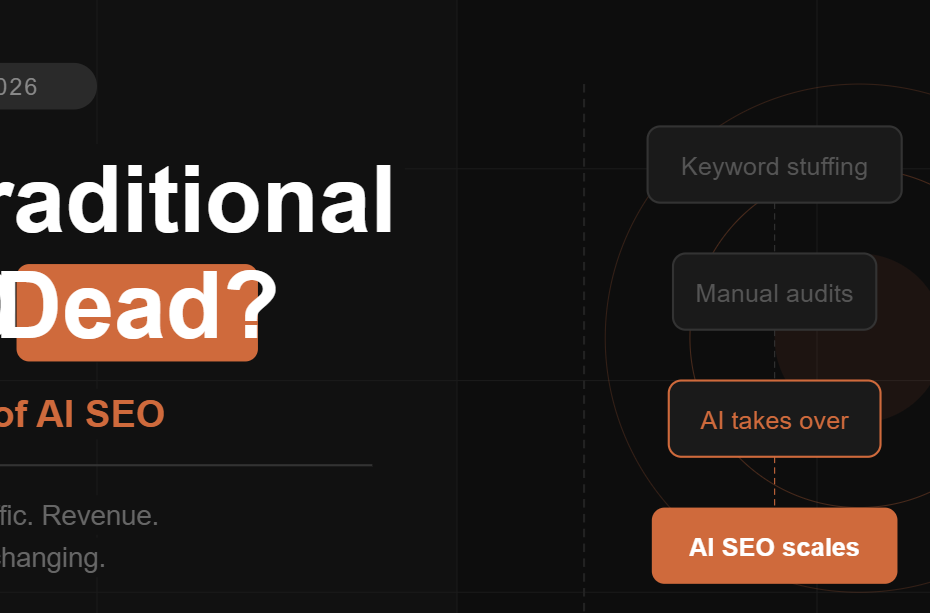
You have probably heard people say it: ‘SEO is dead.’ But is that really true? And if not, what has changed?
The short answer is: traditional SEO as we once knew it is fading. But SEO itself is very much alive — it has just evolved. This article looks at what has changed and why AI SEO is now leading the way.
What Do We Mean by Traditional SEO?
Traditional SEO refers to the practices that dominated from the early 2000s through the mid-2010s. This included keyword stuffing, building large amounts of low-quality backlinks, spinning articles, and chasing algorithm loopholes.
For a while, these tactics worked. But Google has been aggressively closing those loopholes ever since. Many of those old tricks now actively hurt your rankings.
Why Traditional SEO Is Struggling
Google’s AI is simply too smart for old tactics now. It understands context, topic depth, user intent, and the quality of writing. It can detect unnatural link patterns and thin content.
If you are still relying on old-school methods — keyword stuffing, link farms, spinning content — you are not just wasting time. You may be getting penalized.
What Has Replaced Traditional SEO?
The answer is AI SEO — a modern approach that uses artificial intelligence to do SEO better, faster, and more accurately.
Instead of chasing algorithm tricks, AI SEO focuses on what Google has always said it wants: helpful content, strong technical foundations, authoritative websites, and great user experiences.
The Rise of AI SEO
AI SEO uses powerful tools that analyze millions of data points to find the best keywords, create better content strategies, run faster technical audits, and build links more efficiently.
These tools do not replace good SEO thinking. They amplify it. A skilled SEO professional using AI tools can do in one hour what used to take a full team one week.
How Google’s Own AI Is Shaping Search
It is not just SEO agencies using AI. Google itself is powered by AI. RankBrain, BERT, MUM, and now SGE (Search Generative Experience) are all AI systems that help Google understand queries at a much deeper level.
This means the SEO tactics that worked five years ago are no longer enough. You need to meet Google at its level — and that means using AI in your own SEO strategy.
What Still Works in 2026
Some things have not changed. Quality content still wins. Genuine backlinks from trusted sites still matter. Fast, well-structured websites still rank better. Clear user experience still reduces bounce rates.
What has changed is how you achieve all of these things. AI makes each of these goals easier, faster, and more precise to accomplish.
The Businesses That Are Winning
The businesses growing the fastest in 2026 are the ones that switched to AI SEO Agency strategies early. They produce more content, earn more links, fix technical issues faster, and adapt to algorithm updates with less disruption.
Their competitors, still relying on traditional methods, are losing ground every month.
Should You Be Worried?
Only if you do nothing. SEO is not dead — it is changing. And change is actually good news for businesses that are willing to adapt.
If you are still using old SEO methods, now is the time to update your strategy. The tools and knowledge are available. The question is whether you will use them.
Final Thoughts
Traditional SEO is not just struggling — many of its old tactics are now actively harmful. The rise of AI SEO is not something to fear. It is an opportunity.
Businesses that embrace AI-powered SEO will build more organic traffic, stronger brand authority, and a competitive edge that only grows over time. The era of AI SEO is here. Will you be part of it?