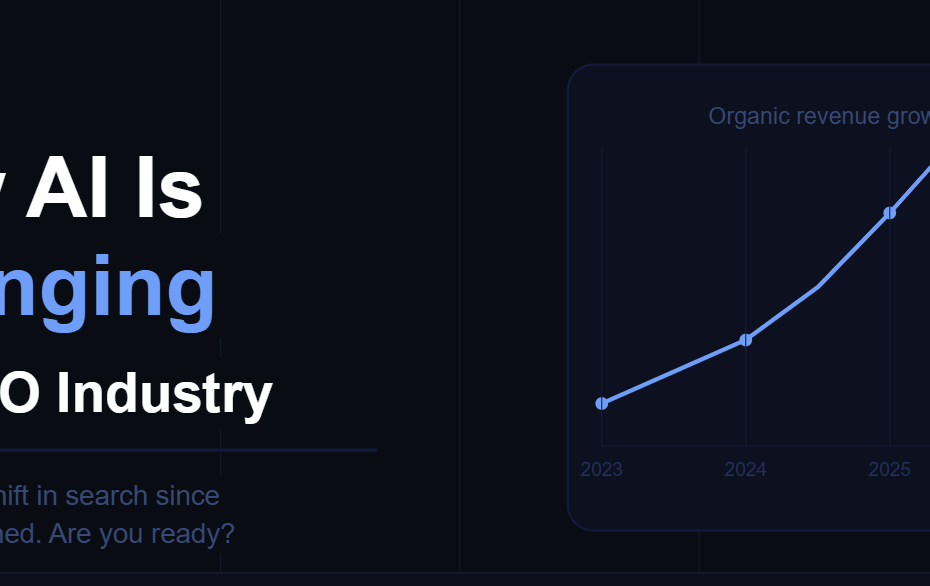
The SEO industry looks very different in 2026 than it did just a few years ago. Artificial intelligence has moved from being a helpful extra tool to being at the very center of how search works — and how businesses compete for traffic.
Here is a look at the biggest ways AI is changing SEO right now.
1. Google Is an AI-First Search Engine
Google has always used AI to rank pages. But in 2026, AI is running the show more than ever. Features like AI Overviews, Search Generative Experience (SGE), and updated versions of RankBrain and MUM mean Google now understands content on a much deeper level.
It no longer just matches keywords. It understands topics, context, and user intent. That changes everything about how you need to create content.
2. Answer Engine Optimization Is Now a Must
Search users in 2026 often get their answers directly on the search results page — without clicking any link. This is called zero-click search.
To stay visible, websites need to optimize for Answer Engine Optimization (AEO) and Generative Engine Optimization (GEO). This means structuring content so AI can pull it as a featured answer.
Working with an experienced AI SEO Agency is one of the best ways to get your content appearing in these AI-generated answers.
3. AI Content Tools Are Everywhere
In 2026, almost every SEO team uses AI to help create content. Tools like ChatGPT, Claude, Jasper, and Gemini have become standard in content workflows.
But quality still matters — maybe more than ever. Google rewards helpful, original, and trustworthy content. Using AI to create thin, generic content can actually hurt your rankings.
4. Topical Authority Beats Keyword Stuffing
AI has helped Google get much better at understanding topics. In 2026, ranking well means covering a topic deeply — not just targeting individual keywords.
This is why building topical authority through content clusters, internal linking, and expert-level writing has become the core of modern SEO strategy.
5. Personalized Search Is Growing
AI allows Google to personalize search results based on location, search history, and user behavior. This means rankings can vary widely between users.
SEO strategies in 2026 need to account for this by targeting specific audience segments, not just generic keyword rankings.
6. Voice and Multimodal Search
With AI assistants getting smarter, voice search is more common than ever. And Google can now process images, videos, and text together — this is called multimodal search.
Optimizing for voice means writing naturally, targeting question-based queries, and giving clear, direct answers.
7. AI-Powered Technical SEO
AI tools now do things that used to take SEO teams weeks to complete. Full site audits, Core Web Vitals fixes, schema markup generation, internal linking suggestions — all automated with AI.
8. Predictive SEO
AI can now predict which keywords are about to trend before they peak. This gives businesses that use predictive SEO tools a big head start on their competitors.
What Does This Mean for Your Business?
The businesses winning in 2026 are the ones that embraced AI SEO early. They have more traffic, better brand visibility, and lower cost per acquisition than those still using outdated SEO methods.
If you have not yet updated your SEO strategy to reflect this new AI-driven world, now is the time.
Final Thoughts
AI has not killed SEO — it has made it more powerful, more precise, and more complex. Businesses that understand these changes and act on them will thrive. Those who ignore them will fall behind.
The SEO landscape of 2026 rewards those who move with AI, not against it.